NIST Digital Forensics Artifact Catalog: Where Digital Evidence Becomes Forensic Science
The Digital Forensics Artifact Catalog (ArtCat) is created by digital forensic practitioners for practitioners, and addresses the need for a structured queryable repository of digital forensic artifacts to support efficient and automated extraction of pertinent information, improving availability and reliability of interpretation of artifacts, and helping establish general acceptance in the scientific community.
Public Release of the NIST Artifact Catalog (ArtCat)
The public release of Artifact Catalog (ArtCat) by the National Institute of Standards and Technology (NIST) is an important milestone in the maturing of digital forensics as a scientific discipline. ArtCat is a curated, community-contributed reference catalog for digital forensics that turns practitioner expertise into shareable, version-aware scientific infrastructure, and it can be found here:
CKE founder and Chief Knowledge Officer, Eoghan Casey, led the original design and development of ArtCat and continues to actively contribute. This catalog was conceived at DC3 and was shared with the community at conferences and through this publication:
Casey E, Nguyen L, Mates J, Lalliss S. Crowdsourcing forensics: Creating a curated catalog of digital forensic artifacts. J Forensic Sci. 2022;67:1846–1857. https://doi.org/10.1111/1556-4029.15053.
“The increasing volume, variety, velocity, distribution, structural intricacy and complexity of use of digital evidence can make it difficult for practitioners to find and understand the most forensically useful information. Digital forensic practitioners currently search for information and solutions in an ad hoc manner, leading to results that are unstructured, unverified, and sometimes incomplete. As a result, certain digital evidence is being missed or misinterpreted. To mitigate risks of knowledge gaps, there is a pressing need for a systematic mechanism that practitioners can use to codify and combine their collective knowledge.” (Casey et al, 2022)
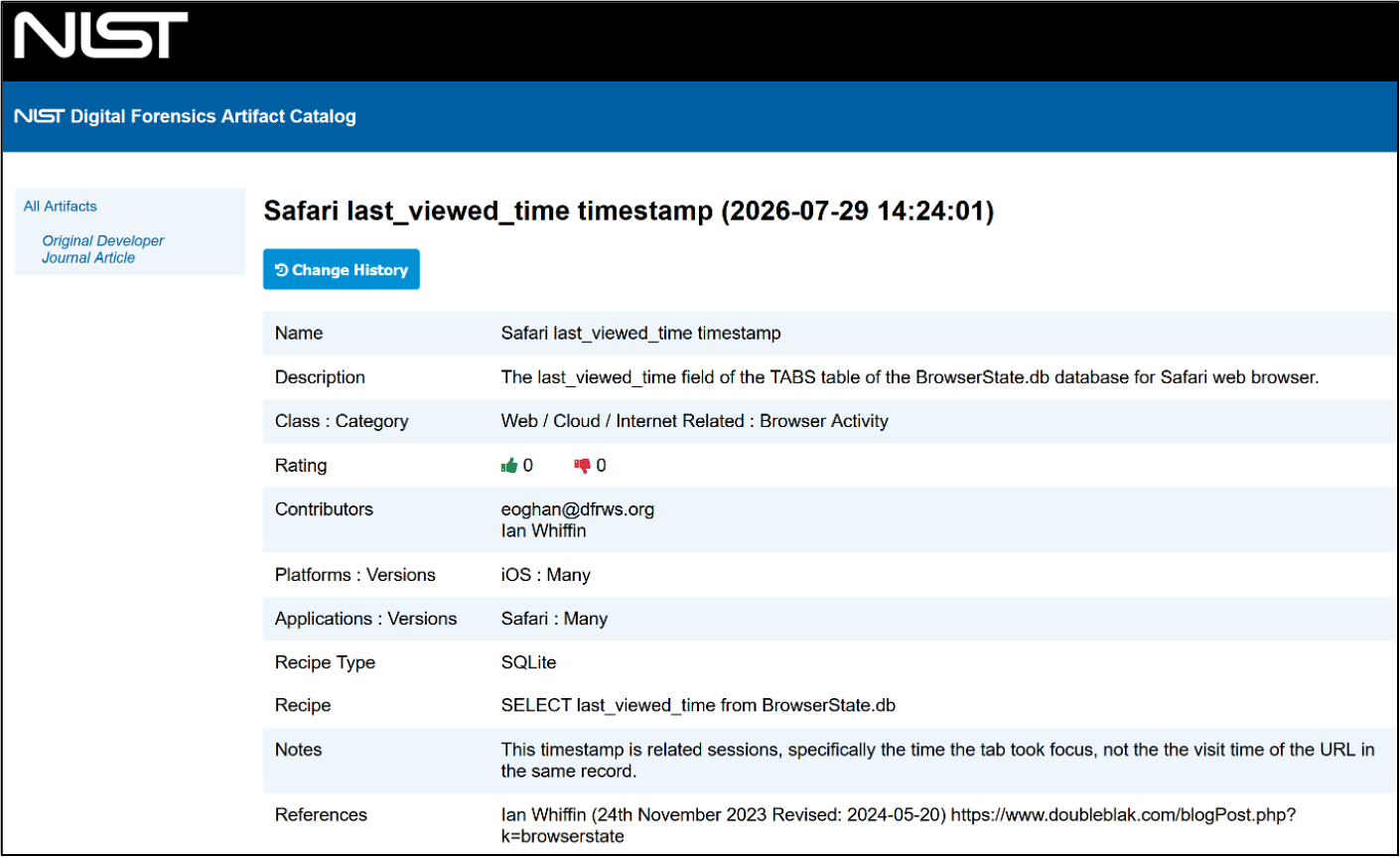
Figure 1: Screenshot from the NIST Digital Forensics Artifact Catalog
Centralizing Forensic Knowledge Bases
ArtCat extends a tradition of forensic disciplines maturing by turning decentralized, fragmented expertise into centralized, structured, shareable, continuously refined knowledge bases. Galton developed a standard way to record fingerprint patterns, and cataloged over 8,000 sets of prints for reference and research. Locard built reference catalogues of trace materials, including dusts, soils, hairs, fibers and inks to support search and study. Goddard compiled data from gun manufacturers to create a library of test-fired bullets and cartridge cases to advance analysis and standardization. In addition to sharing knowledge and unifying understanding, such structured catalogs provide classification that allows an artifact observed in an investigation to be compared against a known, organized body of reference material. Importantly, these catalogs were maintained and operated by an institution with resources to validate entries and make them available to the wider community.
The atomic artifact: sharing knowledge that reaches inference
“An atomic artifact is not just any piece of data extracted from a data source; it is one that answers questions in forensic investigations.” (Casey et al, 2022)
ArtCat captures collective knowledge to create shared, generally accepted understanding. A crucial contribution of the catalog is the precise definition of the atomic artifact as a singular unit of interpretable data that answers an investigative question. The unit of standardization is no longer a file but the inference-bearing elements within it. ArtCat goes beyond referencing a file or database that contains various details; it delves deeper into a specific timestamp, geocoordinate, cashtag, encryption key, or another item within the data structure, along with its specific meaning.
In addition to an ArtCat entry referencing a specific unit of data, it provides context including the platform, application version, and interpretation with supporting citations. Each entry in ArtCat can be classified using concepts defined in the CASE ontology (Cyber-investigation Analysis Standard Expression), which provides the common language and standard structure necessary for shared understanding and machine-readable representation (Casey et al, 2017).
Providing a formalized way to express that a particular piece of information supports a certain interpretation is what converts individual judgment into shared understanding. The digital forensic community can collectively validate the meaning of the information and its general acceptance in the scientific community. Any digital forensic examiner in the world, using different tools, can now produce findings about the same atomic artifact that are mutually intelligible and independently verifiable. ArtCat provides a mechanism for anyone to add, revise, and refine entries and track the change history.
Practical applications
ArtCat can be useful at all phases of digital forensic investigation.
At a crime scene, a digital investigator confronting an unfamiliar device can query ArtCat to learn what categories of evidence it is likely to contain — informing the decision to seize and preserve.
In the laboratory, a digital forensic practitioner examining an evidential Android device can issue a combined query such as Geolocation AND Android and retrieve every catalogued atomic artifact bearing on location, regardless of which application produced it, and learn what each entry means.
A digital forensics intelligence analyst can query ArtCat for connective artifacts indicating that a given device is connected with other devices.
A tool developer can query ArtCat to identify atomic artifacts their product does not yet support, closing real coverage gaps.
A legal professional establishing Daubert admissibility points to the community validation behind a specific interpretation.
In addition, community input to ArtCat can provide a feedback function and useful statistics: “Aggregated voting results can help determine which artifacts are most widely used and confirmed across the community. In addition, the value and acceptance of artifacts can be assessed by tracking the frequency of specific artifacts occurring and being used to address associated investigative questions (5WH). This aggregated information can assess the reliability and stability of artifacts, which helps to establish general acceptance.” (Casey et al, 2022)
NIST stewardship
Forensic disciplines reach maturity by formalizing expertise into structured, shareable, continuously refined knowledge under institutional stewardship. The combination of community contribution with expert curation — administrative review, validated tagging, voting mechanisms that surface community consensus — is the structural answer to the volume and velocity problems that has hindered earlier efforts to create a catalog of digital artifacts. NIST hosting ArtCat is the same structural leap that turned fingerprint bureaus, trace libraries, and ballistics laboratories into permanent scientific infrastructure a century ago. It signals that the catalog is not a project but core operational infrastructure of the discipline — and that the consistency, accuracy, and general acceptance it enables can now be relied upon across jurisdictions, tools, and decades.
Contribute to NIST ArtCat
Raise your reputation as a subject matter expert, and elevate the maturity of digital forensics as a forensic discipline by contributing to ArtCat.